Geespace signs deal with Pakistan’s Paksat on satellite connectivity
Geespace signs deal with Pakistan’s Paksat on satellite connectivity
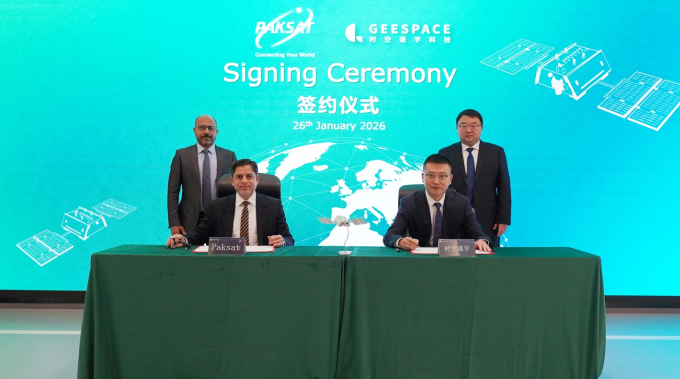
BEIJING, Jan 30 (APP): Chinese commercial space firm Geespace, a subsidiary of Geely Holding, has signed a cooperation agreement with Pakistan’s satellite communications operator Paksat International to support the rollout of satellite-based connectivity services in Pakistan and nearby markets, Geespace said in a Jan 26 statement.
“This partnership aims to enhance [Pakistan’s] digital infrastructure, improve connectivity in remote areas, and support the region’s growing digital economy,” Paksat said in a Facebook post on the same day.
The cooperation will focus on policy coordination, technical cooperation and market development for Geespace’s low-Earth-orbit satellite IoT constellation in Pakistan and surrounding areas, the Geespace’s statement said.
Under the agreement, Paksat will assist with policy engagement, spectrum coordination and compliance-related matters required for commercial operations in Pakistan, while the two sides will also explore cooperation on network access, service integration and marketing, according to the statement.
Geespace Chief Executive Wang Yang said the company would provide “all-weather” and “high-reliability” satellite communications services tailored to needs such as coverage gaps in hard-to-reach regions, industrial digitalisation and cross-regional communications support.
Pakistan has sought to expand digital infrastructure, but operators face high costs and long build-out cycles in mountainous and sparsely populated areas, leaving coverage gaps that satellite services could help address. Satellite links can also be used as backup communications when terrestrial networks are disrupted, China Economic Net (CEN) reporter understands.
Paksat, established in 2004, operates Pakistan’s commercial satellite capacity and provides services to broadcasters, telecom operators, internet and data service providers and government agencies, according to its corporate profile.
Geespace is building and operating a low-Earth-orbit satellite IoT constellation known as GEESATCOM and has completed six launches from 2022 to 2025, with 64 satellites currently in orbit. It has partnered with telecom operators and completed overseas commercial validation tests in more than 20 countries.