ISLAMABAD, Jan 29 (APP):Speakers at an international seminar organised by the Consortium for Asia-Pacific and Eurasian Studies (CAPES) on Thursday underscored the vast untapped potential for expanding Pakistan–South Korea cooperation in the fields of culture and education. The hybrid seminar titled “Pakistan–South Korea Relations: Expanding Cultural and Educational Connectivity” brought together ambassadors, scholars, practitioners and academics from both countries to explore avenues of engagement beyond traditional economic frameworks by exploring …
Pakistan-Korea collaborating on a ‘Knowledge Corridor’: Envoy
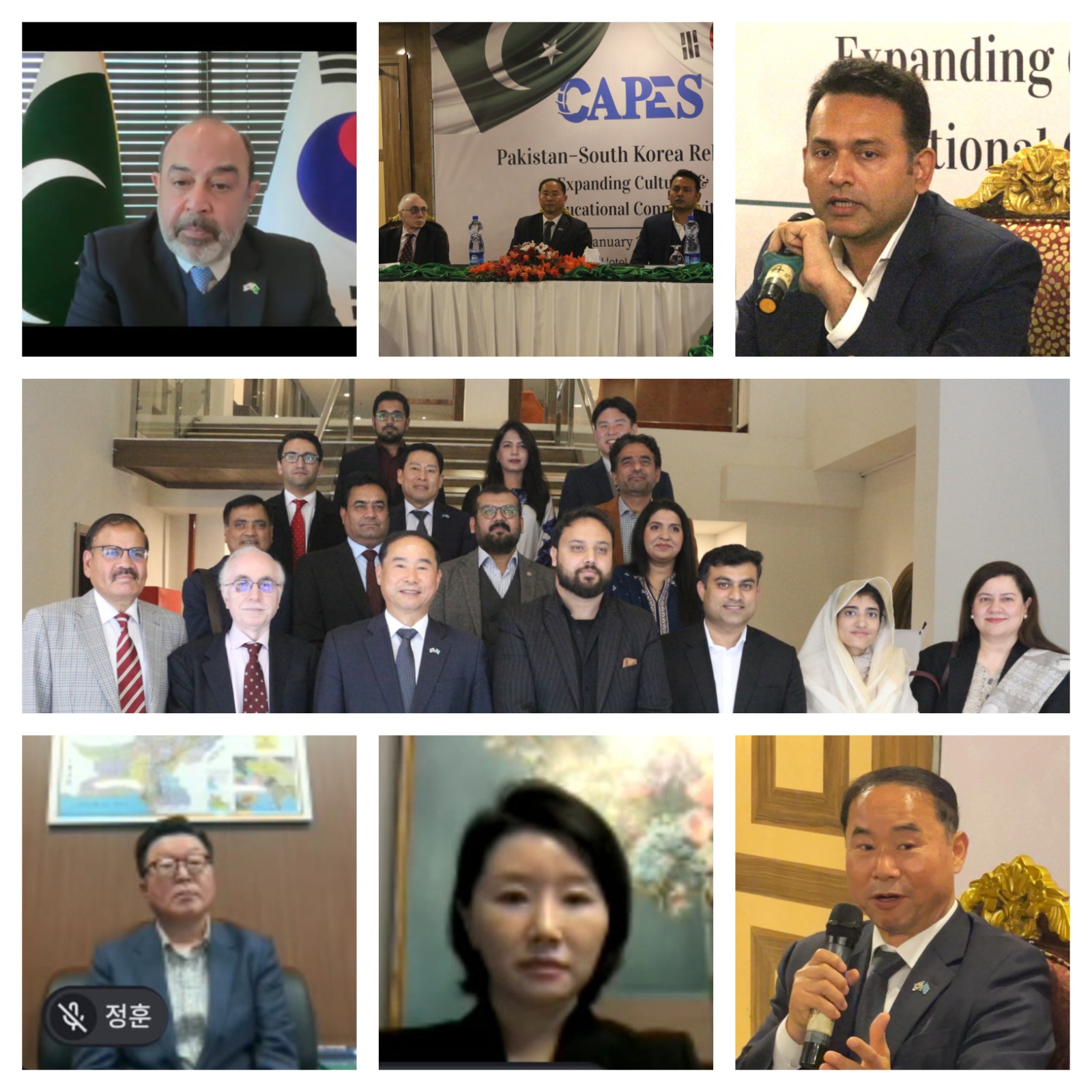
ISLAMABAD, Jan 29 (APP):Speakers at an international seminar organised by the Consortium for Asia-Pacific and Eurasian Studies (CAPES) on Thursday underscored the vast untapped potential for expanding Pakistan–South Korea cooperation in the fields of culture and education.
The hybrid seminar titled “Pakistan–South Korea Relations: Expanding Cultural and Educational Connectivity” brought together ambassadors, scholars, practitioners and academics from both countries to explore avenues of engagement beyond traditional economic frameworks by exploring cultural, people-to-people, and academic connections, said a press release.
The seminar began with opening remarks by Dr Khuram Iqbal, President of CAPES, who underscored the growing importance of public diplomacy in shaping Pakistan–South Korea relations. He pointed out that a growing number of Pakistani students are now exploring educational opportunities in Asia Pacific. China, Australia, Japan, and South Korea are now at the forefront. These countries rank high in innovation, host world-class universities, and—most importantly—remain open to global talent.
Delivering the keynote address, Syed Moazzam Shah, Ambassador of Pakistan to South Korea announced that both the countries are collaborating towards “Pakistan-Korea Knowledge Corridor”. There are currently 1600 Pakistani students enrolled in Korean universities, a number soon likely to increase manifolds in the near future. To address the language barrier challenge Punjab government and Korea embassy engaged and established 4 language centers in Lahore. He also highlighted that Korea has increased the quota for unskilled labor, from 4200 in 2024 to 5400 in 2025.
Pakistan’s Defense Attaché, Col. Asif Mehmood informed the audience that in April this year representatives of more than one dozen Korean Universities will be coming to Pakistan to partipcate in Pakistan-Korea educational expos in Islamabad and Lahore. We are working on a Kartarpur style corridor to promote religious tourism at Buddhist cultural sites in Pakistan.
Ambassador Masood Khalid, Former Ambassador of Pakistan to South Korea, provided a historical overview of Pakistan–South Korea relations. He stated that Pakistan was at the forefront in extending help to South Korea during the Korean War. Both Korea and Pakistan are members of United for Consensus at the UN, the UN group advocating for the expansion of non-permanent members of the Security Council.
The academic session featured insights from Pakistani and Korean scholars examining education and culture as drivers of bilateral engagement. Dr. Mun Yong Jo, President of the International Interchange Development Association, underscored the role of digital connectivity in promoting Korean language courses in far flung areas of Pakistan. He was of the view that Pakistan’ rich human and natural resources combined with Korea’s advanced technology and economic expertise create a win-win prospects for both the countries.
Prof Choi Jong In, vice President of Tongwon University South Korea shared that his university is soon going to establish a campus in Lahore as a part of “Pakistan-Korea Knowledge Corridor”.
Dr Sobia Hanif from Fatimah Jinnah Women University, Dr Hyang Joo Lee, from Pukyong National University, South Korea, Dr Mahmood Awan from SolBridge International School of Business, South Korea, Dr Adeel Irfan Rao from University of Sargodha and Dr Ahtisham Hussain, Former Head of the Department of Korean Language and Culture at NUML also addressed the audience during the seminar.