
PESHAWAR, Jan 24 (APP):For more than a decade, millions of rupees’ worth of valuable timber has lain silent and exposed across the forests and depots of Khyber Pakhtunkhwa where its economic potential slowly eroding under sun, rain, and policy paralysis. From Malakand to Hazara, stacks of deodar, kail, and fir timber, which was harvested legally as dry windfall wood, remain unsold due to a long-standing ban imposed in 2014 by …
Frozen forest wealth: Windfall Timber Policy stalemate costs KP billions
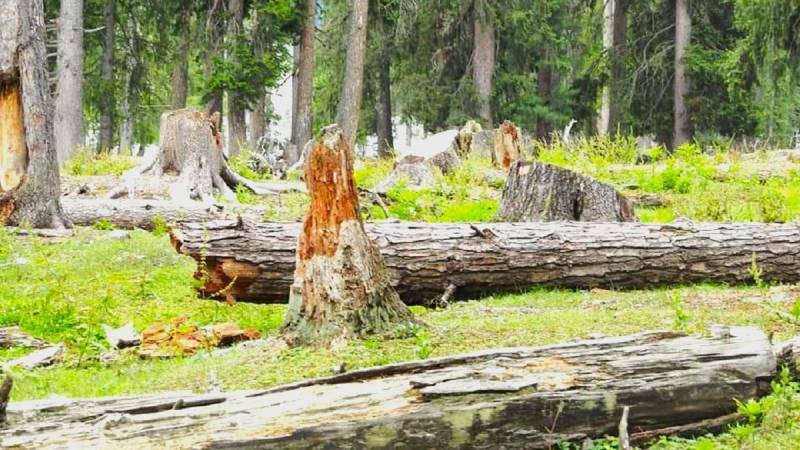
PESHAWAR, Jan 24 (APP):For more than a decade, millions of rupees’ worth of valuable timber has lain silent and exposed across the forests and depots of Khyber Pakhtunkhwa where its economic potential slowly eroding under sun, rain, and policy paralysis.
From Malakand to Hazara, stacks of deodar, kail, and fir timber, which was harvested legally as dry windfall wood, remain unsold due to a long-standing ban imposed in 2014 by the PTI Government.
What was once considered a conservation measure has now become a source of growing concern for traders, farmers, economists, and forest officials alike.
“We are watching money rot in front of our eyes due to long ban on dry windfall timber policy,” said Hamdard Ali, a seasoned furniture trader in Nowshera district.
His two rooms furniture workshop on main GT Road at Pabbi tehsil , once bustling with carpenters, now operates at a fraction of its capacity despite rising furniture demands amid weeding season.
“The ban on dry windfall timber has pushed up the cost of household wood projects in KP,” he said. “Raw material is scarce, prices have doubled, and small furniture makers are being forced out of business.”
According to Ali, timber worth millions of rupees remains locked in forest depots, particularly in Malakand and Hazara divisions. He urged Chief Minister Sohail Afridi to personally intervene and resolve what he termed a “needless and damaging delay.”
The economic implications of the stalled policy are staggering and need urgent measures to lift the uncalled for ban on stocked timber. Dr Zilakat Malik, former Chairman of the Economics Department at the University of Peshawar, warned that the province is likely sitting on losses running into billions if policy was not reviewed.
“Timber worth approximately Rs 6.05 billion is currently lying idle in Malakand and Hazara forest circles,” he claimed. “If the ban continues, much of this raw material will go to waste and KP will badly suffer economically.”
Breaking down the figures, Dr Malik said timber valued at Rs450 million lies in eastern Malakand, Rs 2 billion in western Malakand, and Rs 3.52 billion in Hazara forest depots and storage sites.
“Guards may be protecting the timber, but its quality is deteriorating rapidly,” he added. “Prolonged exposure to extreme weather, along with threats of fire, floods, and theft, could wipe out billions in public assets.”
Officials in KP Forest Department acknowledged the gravity of the situation and say steps are finally being taken to unlock the frozen forest resources.
Latifur Rehman, spokesperson for the forest department, told APP that Managing Director of the Forest Development Corporation (FDC), Ahmad Zaib, recently briefed senior officials on the status of the long-pending timber settlement.
“Millions of cubic feet of dry windfall timber felled over previous years are lying at timber markets, roadside depots, forest areas, and along transit routes,” he said.
A large quantity is stored at the Chakdara timber depot, while the rest is scattered across locations such as Allai Battagram and Arandu in Lower Chitral. The bulk of the stock lies in the Malakand Forest Circle, consisting mostly of high-value species.
According to the forest department, long delays stem from multiple factors such as the 2014 suspension of the Dry Windfall Policy, prolonged litigation, complex third-party verification procedures, policy gaps, and limited workable months for timber transportation.
To prevent further losses, he said the department has proposed immediate auctions of timber at Chakdara and authorization for harvesting and disposal of stock lying in forests and along transit routes.
“These measures will revive stalled investments, generate revenue, and bring long-pending forest produce into a formal settlement framework,” Lateefur Rehman said.
The Secretary of the Department of Climate Change, Forests, Environment and Wildlife, Junaid Khan, reaffirmed the government’s commitment to resolving inherited forestry challenges including windfall policy.
A comprehensive summary is expected to be presented to the provincial cabinet soon for a final decision.
For traders like Hamdard Ali and countless workers in the furniture and construction sectors, that decision cannot come soon enough.
“This timber is not just wood,” Hamdard Ali said quietly. “It is livelihoods, homes, and economic dignity—lying wasted while most people in KP struggle economically.”