ISLAMABAD, Jan 14 (APP): Deputy Prime Minister/Foreign Minister Senator Mohammad Ishaq Dar, Wednesday, while stressing upon consistency in policies, urged all the stakeholders to strive further to achieve economic strength and carve a niche for Pakistan among the comity of nations. In his address as the chief guest at “Pakistan Policy Dialogue” closing session, he said that when they took reins of the government, they inherited a deep economic imbalance, …
DPM/FM says Pakistan blessed with precious resources; urges stakeholders to strive for economic strength
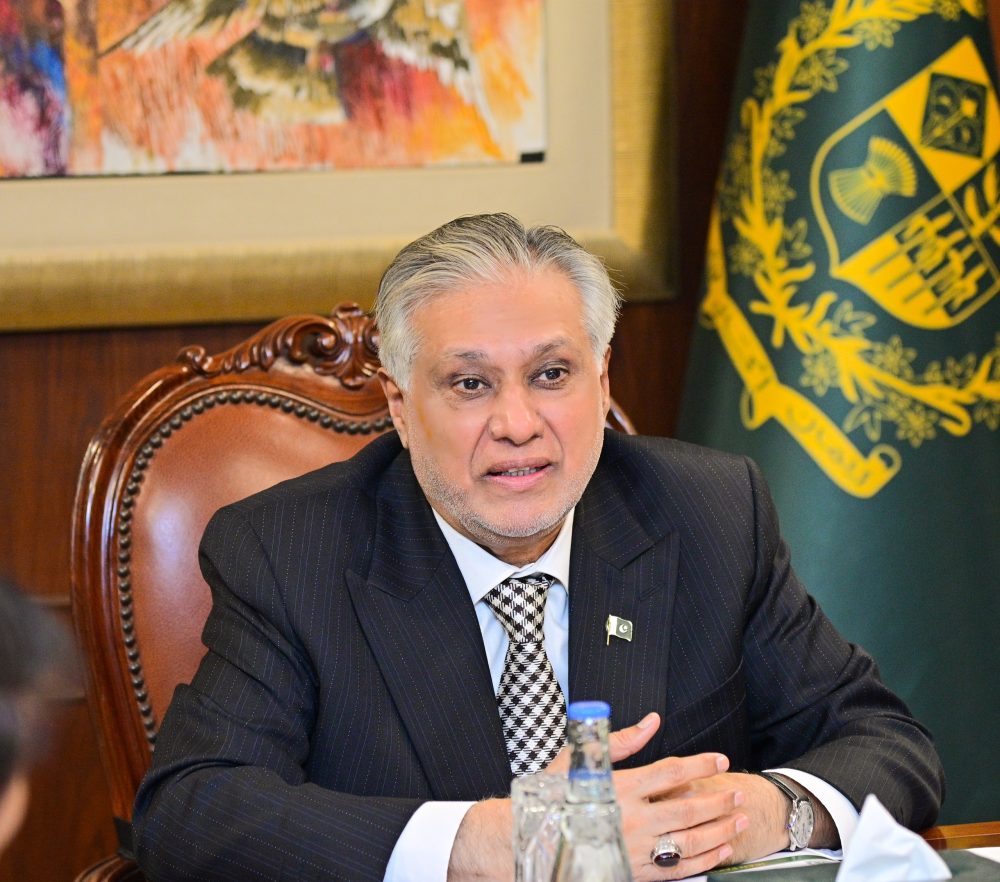
ISLAMABAD, Jan 14 (APP): Deputy Prime Minister/Foreign Minister Senator Mohammad Ishaq Dar, Wednesday, while stressing upon consistency in policies, urged all the stakeholders to strive further to achieve economic strength and carve a niche for Pakistan among the comity of nations.
In his address as the chief guest at “Pakistan Policy Dialogue” closing session, he said that when they took reins of the government, they inherited a deep economic imbalance, reacted with a singular priority; Pakistan long-term interests.
Difficult decisions were taken and political comfort was set aside in preference to discharge responsibility, he added.
He said under the leadership of Prime Minister Shehbaz Sharif, reforms were now being implemented with clarity and purpose, adding they were systematically addressing long-standing inefficiencies, including privatization of major public sector enterprises.
About privatization process, he said there was no disagreement across the entire spectrum of the business community that this should be one of the top priority. The privatization of PIA had been successfully completed after more than two decades of effort, he added.
The DPM/FM, in his speech broadcast on national Tv channels, opined that the process would modernize the airline but also would reduce the financial burden on the national sector.
“It has sparked significant interest from both domestic and international investors, boosting confidence in Pakistan’s broader privatization programme and paving the way for further economic restructuring,” he added.
He stressed that they had to work hard and that effort had to be done consistently by every next government which joined in.
“The promise policies must be consistent. So things are shaping up. We should not lose hope. We should work extra hard and Pakistan has a place to achieve,” he added.
Dar further said for reducing the circular debt, the government was enforcing payment discipline, strengthening regulators and building a financially sustainable energy sector, adding the goal was to ensure that energy supported the economic growth instead of constraining it.
About rightsizing and reforms, the DPM/FM said they were eliminating inefficiencies, cutting waste and reorienting public spending towards productivity and service delivery.
These reforms together with digital governance initiatives ensured government resources were used effectively for the benefits of the people. These reforms complemented the macroeconomic stability that Pakistanis demanded and deserved, he added.
Referring to economic situation in 2023, Dar said the businesses were down and growth was almost nil, costs had gone upto 22%, but he always told the businessmen that Pakistan had great potential.
Referring to the year 2017, the DPM/FM Dar said Pakistan at that time was a macroeconomic stable country, interest rate was down to one of the lowest 5.25, export rate finance 3.25 and growth rate hovered at 6.3%.
“So that shows the country has the potential. The business community can lead that growth,” he added.
He said that the focus of the incumbent government was on achieving the stability, adding all the rating agencies had upgraded Pakistan’s ratings.
The DPM/FM further emphasized that Pakistan had the potential. It was only a matter of going in the right direction.
“You’re already nuclear power. God has blessed you with missile power. And the only thing lacking is the full economic flotation and independence. Can Pakistan have it! Of course, indeed. This is my belief, my faith,” he added.
Dar reiterated that government’s function was not to do the businesses rather to provide an enabling environment.
“This is the key priority of this government. After PIA, we would be unbundling and unwinding many other areas. I try to do with as much speed as I can as chairman of the cabinet committee on privatization,” he added.
This government, he said, had a very clear roadmap. The current token deficit had turned into surplus while the revenue tax to GDP increased by 2%. The inflation had come down to 5.6% CPI. Pakistan’s stock exchange made a new mark and a new record.
He said the country was blessed with mineral resources and the hydrocarbons, the stones and the most conservative estimate was six to eight trillion dollars. About foreign loans, Dar underlined the need to plug the gap of external account gap and said all they needed was about 10 billion increase in remittances, 10 billion increase in exports and maybe 10 billion services and other sectors.
The DPM/FM said they had embedded geo-economics into every major foreign policy channel, adding ‘a country which was known to be diplomatic isolated just three years back is today, Alhamdulillah is most relevant in the region, most desired to be connected.’
“We are also advancing, advancing mineral and energy cooperation to support sustainable growth while improving regional connectivity through transport and logistics links, including Gwadar port and the Karakuram highway,” he added.
The DPM/FM further said that Pakistan-China, all weather strategic partnership was set to strengthen the long-term economic collaboration and deliver tangible benefits for the people of both countries.
With the United States, he said their cooperation spanned technology, energy, investment, and market access, aimed at strengthening Pakistan’s export competitiveness and creating new opportunities for trade and growth.
Across Europe, they were strengthening access with the business community. In the Gulf, with Turkiye and across the Middle East, major investments and strategic partnerships were accelerating in energy, food, security, logistics, service, and technology.
These economic engagements complement the long-standing security cooperation and remained central to Pakistan’s FDI strategy, he added.
Dar further enumerated that Pakistan’s growth should be green, digitally enabled, and human capital driven. Climate smart, agriculture, renewable energy, sustainable urban development and green industrial incentives were central to this agenda and to Pakistan’s resilience.