Alaska Airlines bets on Boeing with its biggest aircraft deal for global expansion
Alaska Airlines bets on Boeing with its biggest aircraft deal for global expansion
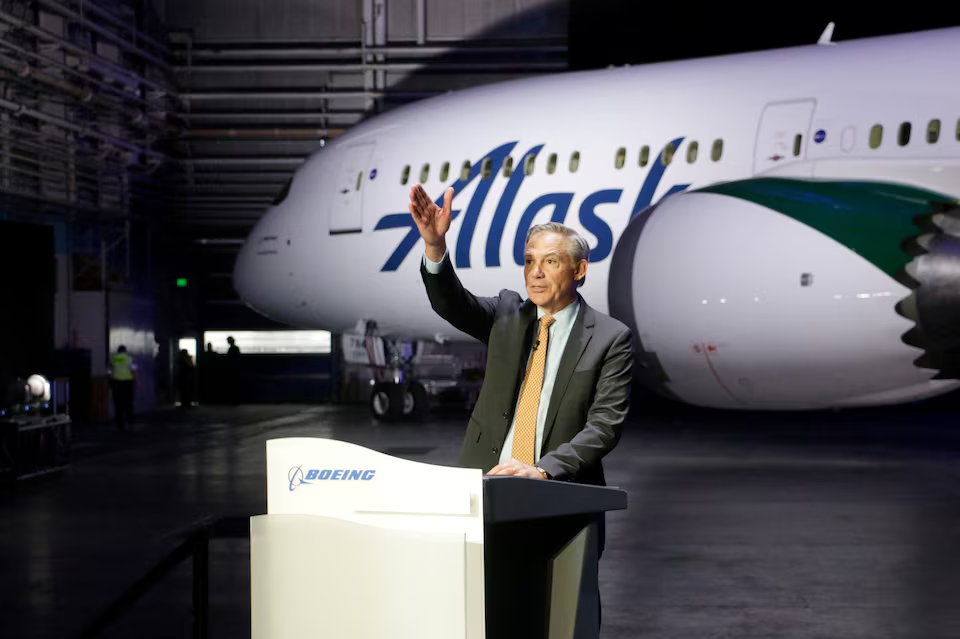
SEATTLE/WASHINGTON, Jan 8 (Kyodo/APP): Alaska Airlines said on Wednesday it will purchase 110 new Boeing aircraft, the largest single order in the carrier’s history, as part of an aggressive expansion and fleet modernization plan.
The Seattle-based carrier has international ambitions with planned launches to Rome and London. The order signals its confidence in Boeing’s corrective measures, quality enhancements, and future aircraft performance — two years after a door plug missing key bolts blew off one of its new jets at 16,000 feet.
That incident sent shockwaves through the aviation industry, disrupting suppliers, carriers, and passengers. Alaska was forced to ground its fleet of MAX 9 aircraft in the aftermath.
“This is about a doubling down of their commitment to the Boeing Company,” Boeing CEO Kelly Ortberg said at an event marking the deal. “We don’t take that lightly. We know that you really need us. You’re doubling down, putting your eggs in our basket, and we need to perform.”
The aircraft order includes 105 737 MAX 10 jets and five 787-10 Dreamliners, along with options for 35 additional MAX 10s. Alaska said the order will help grow its fleet from about 413 aircraft today to more than 475 by 2030 and over 550 by 2035, including 17 long-haul 787s.
Shares of both companies initially rose after the news, but Alaska’s shares closed down 2% while Boeing’s closed 0.75% lower.
“We are creating the fourth global airline in our country to compete against the ‘Big Three,'” Alaska CEO Ben Minicucci said at an event Wednesday. “We’re going to compete against the Big Three and win. And that’s what this is all about.”
Alaska has taken steps to improve safety and quality oversight, deploying its own inspectors to Boeing’s production lines and instituting quarterly audits.
Minicucci told CNBC on Wednesday the carrier has observed steady progress at Boeing and is confident the U.S. planemaker is delivering top-quality aircraft.
The wide-body 787 Dreamliners will drive Alaska’s push into long-haul international markets, including Europe and Asia, while the larger narrow-body 737 MAX 10s will bolster domestic operations and replace older aircraft, Minicucci said in an interview after the event.
Minicucci said the fleet deal secures a streamlined delivery schedule for the next decade and supports Alaska’s ambition to become the nation’s fourth global carrier.
Alaska is integrating its operations with Hawaiian Airlines, which it bought for $1.9 billion in 2024, while maintaining separate branding. The company already operates the two airlines with a single operating certificate, Minicucci said.
The company expects to unify the passenger service systems for the two airlines by late April, Chief Financial Officer Shane Tackett said in an interview.
The company wants to secure joint union contracts with each of the major groups of workers, including pilots, cabin crew and maintenance workers, he said. “They’ll all be able to work in any part of the system that they might want to,” giving the company more flexibility for staffing as it expands.
“So, when we want to grow, we can grow faster,” Tackett said, adding he hoped those agreements can be reached this year.
The new Boeing order provides the capacity, range and unit-cost economics to integrate networks, add domestic frequencies and launch new long-haul services.
Alaska is exercising 52 existing options for MAX 10 airplanes and placing orders for 53 new planes. Minicucci voiced confidence that the MAX 10 will achieve certification. If certification is again delayed six months or longer, “we would sit down with Boeing and likely end up switching a few of the 10s to a (MAX) 9 or 8 variant,” Tackett said.
Alaska said the five additional 787s will enable it to fly to at least 12 long-haul international destinations from Seattle by 2030.
Boeing is working to stabilize its 737 MAX program after years of certification delays and heightened oversight. In October 2025, the FAA cleared Boeing to raise 737 MAX output to 42 jets per month, easing a 38-per-month cap imposed after the door-plug incident.
The planemaker is still seeking FAA approval for the MAX 7 and MAX 10, with certification schedules pushed into 2026 amid an unresolved engine anti-ice design issue.