By Khalid Taimur Akram The year 2025 will be remembered as one of the most important and blessed years in Pakistan’s diplomatic history. This year can be described as the year of renewed momentum for Pakistan at the economic and diplomatic fronts. After navigating the complex and uncertain global environment for so many years, Pakistan not only strengthened its international relations but achieved strategic partnerships also, emerged as a reliable …
Pakistan’s diplomatic comeback: How 2025 changed global narrative
By Khalid Taimur Akram
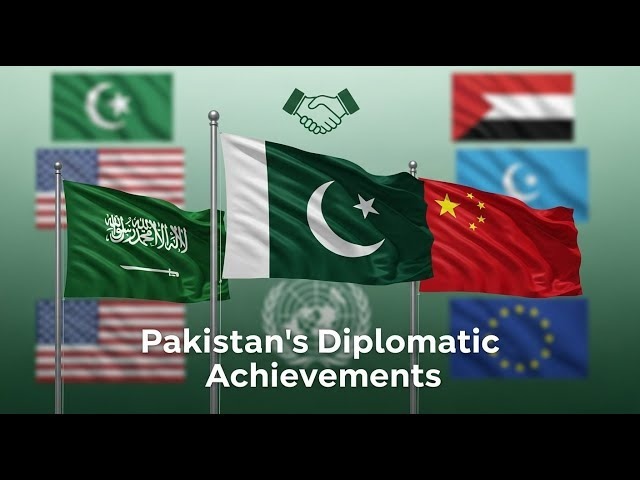
The year 2025 will be remembered as one of the most important and blessed years in Pakistan’s diplomatic history. This year can be described as the year of renewed momentum for Pakistan at the economic and diplomatic fronts. After navigating the complex and uncertain global environment for so many years, Pakistan not only strengthened its international relations but achieved strategic partnerships also, emerged as a reliable partner for the international community and became a respected voice on key global issues. From major security pacts and proactive international and regional engagement through foreign visits to global eminence and recognition, Pakistan has shown that it is pursuing a visionary foreign policy.
This year we have seen decisive turnaround for the country. The revival of diplomatic relevance and the strategic partnerships along with economic stabilization and reform led recovery could be seen. If we talk about the diplomatic wins and strategic alignments, there is a list of success that Pakistan has achieved at the diplomatic front. The credit goes to Pakistan’s diplomats, military leaders and the political leaders who were extremely active in 2025. Prime Minister Shehbaz Sharif, President Asif Ali Zardari, Foreign Minister Ishaq Dar, and the Field Marshal Syed Asim Munir, travelled extensively around the world to strengthen ties with key partners within and beyond the region. In total, they made 71 foreign trips collectively to promote Pakistan’s foreign relations and strategic interests.
These trips were not for show and pomp, but were meant to revive Pakistan’s relations with major powers and the newly emerging powers. The frequency and range of these visits signaled a confident Pakistan that is eager to expand its influence and always ready to cooperate with the world.
Visits of Regional Leaders to Pakistan
The year 2025 began with a visit by the Turkish President Recep Tayyip Erdogan to Pakistan, where the historic bonds between Pakistan and Türkiye were reinforced. This visit of the President Erdogan proved to be a historic moment in Türkiye-Pakistan bilateral relations because it resulted in 24 agreements and memoranda across military, trade, economy, health, technology, agriculture, and other areas. Furthermore, the commitment of both countries’ heads to achieve the target of $5billion volume of bilateral trade proved their strong political will to deepen economic cooperation between the two brotherly nations.
The visit by Iranian President His Excellency Dr. Masoud Pezeshkian carried greater significance since it was his first official visit to Pakistan since assuming office in July 2024. The Iranian Foreign Ministry described the visit as the start of a “new chapter” in bilateral engagement. The visit culminated in the signing of 12 Memoranda of Understanding (MoU)/agreements, covering diverse sectors such as trade, energy, border management, cultural exchange, and scientific cooperation and also set the target of $10 billion volume of trade between both sides. This visit was a diplomatic achievement for Pakistan, one since it was President Pezeshkian’s first visit to Pakistan after assuming office, second, it laid a solid foundation for advancing bilateral cooperation across economic, security, cultural, and political domains, and third, Islamabad’s hosting of the Iranian President reinforced Pakistan’s commitment to proactive diplomacy and a balanced approach to international engagement.
The recent visit of President of Kyrgyzstan Sadyr Zhaparov was a diplomatic milestone because it was the first visit by a Kyrgyz head of state to Pakistan in 20 years. Both sides agreed to significantly boost their trade from $15 million to $200 million within two years. Along with this 15 MoUs were signed as well. This visit marked a significant step in revitalizing bilateral relations after a long diplomatic gap. It also reflected that both sides are determined to expand cooperation beyond symbolic ties.
A a few days ago on Dec 26, 2025, the President of the United Arab Emirates and Ruler of Abu Dhabi Sheikh Mohamed bin Zayed Al Nahyan, undertook first official visit to Pakistan. Although Pakistan and UAE enjoy the fraternal bonds but this visit is an effort to further strengthen those bonds through a “quantum jump” in economic cooperation. The UAE President showed interest in investment, energy, trade, and infrastructure. During the visit, a landmark agreement was signed under which the UAE committed to purchasing shares worth $1 billion in Pakistan’s Fauji Foundation. Overall, it signaled a shift toward a more robust, investment-driven relationship aimed at mutual economic growth and regional stability.
Earlier, Jordan’s King Abdullah II, Malaysian Prime Minister Datuk Seri Anwar Ibrahim, Indonesian President Prabowo Subianto, and Kazakhstan’s Deputy Prime Minister Murat Nurtleu, also paid official visits to Pakistan.
From Battlefield to Diplomacy: Marka-e-Haq and the US Policy Shift
The highlight of the year 2025 was the Marka-e-Haq, also known as the May stand-off, between India and Pakistan in which Pakistan stood victorious and emerged as a regional player. Pakistan effectively projected its principled stance at regional and global forums. It exposed the Indian hegemonic designs to the world and showed that Pakistan is a peace-loving country but will never compromise its sovereignty. Pakistan also debunked India’s exaggerated claims and exposed Indian media’s misinformation and propaganda against Pakistan to the world. Pakistan’s restraint—avoiding deep escalation despite India’s provocations—set the stage for its diplomatic offensive, framing it as a responsible actor committed to stability.
In the aftermath of this tense conflict, Pakistan not only won in the battlefield but also excelled at the diplomatic front. China, USA, Russia, Turkiye, Iran, and so on, everyone praised Pakistan, its leadership, its military, and Pakistan’s proactive diplomacy. Pakistan became a game changer helping various countries sit together and achieve peace.
The delegations sent by Pakistan to Moscow and western capitals for lobbying on tensions with India received positive responses from officials, think tanks, and international stakeholders. It marked another significant diplomatic achievement for the country. These efforts to highlight Pakistan’s peaceful and responsible stance on regional developments, while advocating for dialogue and stability in South Asia, were well received. The meetings strengthened Pakistan’s international image and diplomatic outreach.
This four-day armed conflict between Pakistan and India in May 2025 was a decisive turning point for Pakistan-U.S. relations also. The United States once again turned to Pakistan and now the Trump administration refers to Pakistan as a reliable partner. President Donald Trump is giving a lot of strategic significance to Pakistan whether it be in the military domain, diplomatic domain or the strategic domain. Pakistan’s Field Marshal Syed Asim Munir was the first military chief that was hosted by the U.S. President and President Donald Trump also referred to Field Marshal Syed Asim Munir as his “favorite field marshal” in his address at the Sharm el-Sheikh Peace Summit.
President Trump also invited Pakistan’s army chief, Field Marshal Asim Munir to lunch at the White House. He then hosted Prime Minister Shehbaz Sharif and Field Marshal Asim Munir again at the White House. Furthermore, President Donald Trump publicly praised the leadership and capabilities of Prime Minister Shehbaz Sharif and Field Marshal Asim Munir on several occasions. Cooperation between the two countries deepened in key areas including defence, counterterrorism, intelligence sharing, and regional security. This shift of Washington towards Pakistan highlighted the growing importance of Pakistan in the international community and key world issues.
Pakistan achieved another major diplomatic victory in December 2025 when a UN expert report officially identified India as the aggressor in the April 22 attack in Occupied Jammu and Kashmir’s Pahalgam region. The report also highlighted violations of fundamental human rights. Despite India’s extensive lobbying, the international community supported Pakistan’s position, boosting its global legitimacy.
PM Shehbaz Sharif’s Diplomatic Engagements Abroad
In year 2025, we have seen lots of diplomatic interactions. Not only the regional leaders visited Pakistan but the Prime Minister of Pakistan His Excellency Mian Muhammad Shehbaz Sharif also paid visits to several countries including Saudi Arabia, United Arab Emirates, United States of America, China, Türkiye, Iran, Azerbaijan, Tajikistan, Uzbekistan, and Belarus. He also participated in multilateral forums such as SCO Summit in China, World Governments Summit in Dubai, Sharm el-Sheikh Peace Summit in Egypt, and so on. All these visits and participation in multilateral forums signal a foreign policy focused on economic revival, regional connectivity, and strategic balancing. Pakistan strengthened ties with Gulf states for investment and financial support. It deepened the long-standing strategic partnership with China. It also expanded partnerships with regional neighbors and friendly states to manage security and connectivity. In essence, this year witnessed Pakistan diversifying diplomacy beyond traditional partners and all these efforts were aimed at reducing isolation, securing investments, and projecting active diplomacy amid regional and economic challenges.
Pakistan and China: A Stronger Strategic Bond
This year we have also seen how Pakistan and China’s diplomatic relations remained strong as they always have been. Pakistan and China elevated their “all-weather strategic partnership” through CPEC 2.0. The trade corridors have already started working and we have seen very successful visit of our Prime Minister to China and B2B conference where CPEC 2.0 was announced. High-level agreements worth over $8.5 billion, covering energy, technology, agriculture, and regional connectivity, also concluded. China also supported Pakistan during the 4 days war between India and Pakistan. Key milestones included quantum technology cooperation and the launch of five new development corridors, cementing a durable, multi-dimensional alliance. China and Pakistan issued a Joint Action Plan for 2025–2029 to build a closer community of shared future, including expanded cooperation in education, technology, and vocational training. Chinese Foreign Minister Wang Yi also visited Islamabad for strategic dialogue amid regional tensions, underscoring continued diplomatic engagement. This enhanced diplomatic engagement between the Ironclad Brothers shows commitment of both the nations to further strengthen the long-term cooperation.
A New Era in Saudi–Pakistan Defence Relations
The friendship between Pakistan and Saudi Arabia reached new heights when both signed a Strategic Mutual Defence Agreement this year. The agreement states that aggression towards one state will be regarded as aggression against both. This is a significant event because it turns the enduring connection into a formal, binding one. The defence pact with Saudi Arabia is the high point of military diplomacy. Although Pakistan and Saudi Arabia and the Middle Eastern Countries have been enjoying a very good military-to-military cooperation but this defence pact is something beyond military cooperation. It is a strong message to the world that Saudi Arabia and Pakistan stand together and that they are willing to defend each other’s sovereignty in full force.
This agreement is an affirmation of Pakistan’s increasing strength. Since Pakistan is the sole nuclear power in the Muslim world with a professional and proven military, so it commands high respect on the global stage. This pact and the growing cooperation between Pakistan and Saudi Arabia have made it clear that Pakistan has taken up the role of a security provider, not just for Saudi Arabia but for the whole Muslim world. The fact that Saudi Arabia has opted Pakistan as its closest military ally is itself proof of Pakistan’s strength and rising stature.
Active Role in Regional Diplomacy
This year Pakistan remained very active in regional diplomacy. Whether it be Palestine issue, Kashmir issue, engagement with Central Asian and Middle Eastern countries, Pakistan remained active. This year Pakistan became a very significant stakeholder in the Middle Eastern region and is being referred to as the stabilizing stakeholder. The Pakistani leadership focused on strengthening relationship with UAE, Saudi Arabia, Pakistan’s and Qatar. Similarly, Pakistan was very vocal about the Gaza crisis and supported ceasefire initiatives, endorsed a US-backed Hamas peace plan, and consistently condemned Israeli actions harming civilians. It also played an instrumental role in United Nations and the Palestine related resolutions and conferences. Islamabad used diplomatic channels to advocate humanitarian access and civilian protection, reinforcing its principled stance on Palestinian rights.
In addition, Pakistan also adopted a principled stance on Kashmir issue especially during and after the India-Pakistan May 2025 conflict. It made clear that Pakistan will never abandon Kashmir and will always fight for the cause of Kashmir. Afghanistan has remained a point of concern throughout this year but Pakistan did not show any hard feelings against Afghanistan also. Instead, Pakistan had been telling Afghan brothers to counter terrorist elements and the terrorism spillover in Pakistan. Even during the 6th Trilateral Foreign Ministers’ Dialogue held in Kabul, Afghanistan and Pakistan along with China focused on counter-terrorism and economic cooperation. The summit concluded with a joint resolve to cooperate in trade, transit, health, education, culture, and narcotics control. This was also a major diplomatic success of Pakistan this year.
The year witnessed an excellent relationship building up between Pakistan and Bangladesh. The visit of Honorable Ishaq Dar, Pakistan’s Foreign Minister and the Deputy Prime Minister, was the first Pakistani foreign‑ministerial visit in around 13 years. It led to signing of multiple MoUs on trade, diplomatic cooperation, cultural exchange and visa arrangements. These steps signaled a significant thawing of diplomatic relations after more than a decade of light engagement.
In short, in the year 2025 Pakistan emerged as a middle power and this year was a turning point for Pakistan’s bilateral ties.
Final Remarks
In 2025, Pakistan showed the world that it can be a proactive, respected, and influential actor on the international stage. Its diplomatic successes came from strategic vision, active engagement, and a willingness to collaborate across continents. Whether in defence alliances, global trade talks, or peace advocacy, Pakistan’s diplomacy helped advance its national interests while earning respect abroad. As we move forward, these accomplishments in 2025 provide a strong foundation of trust, partnership, and international relevance. This year is a reminder that when Pakistan speaks diplomatically, the world listens.
The writer is Executive Director, Pakistan Research Center for a Community with Shared Future (PRCCSF), Islamabad.