Across China: Centuries-old Kunqu opera finds new life with youthful energy
Across China: Centuries-old Kunqu opera finds new life with youthful energy
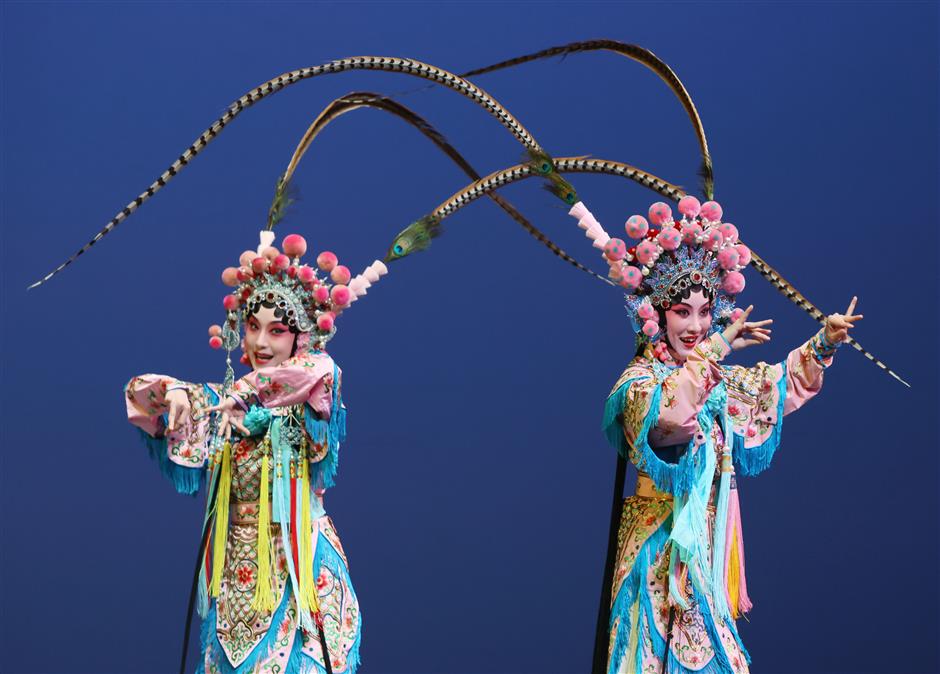
NANCHANG, Dec. 26 (Xinhua/APP): For 22-year-old Zou Yu, a student in the opera class at Fuzhou Vocational Technical College in east China’s Jiangxi Province, the day usually begins at 5 a.m.
Every day, she and her classmates undergo eight hours of intensive training, covering everything from basic skills and body movements to singing and stage rehearsals.
Studying the 600-year-old Kunqu Opera is by no means easy. Three years ago, she fell face-first during a back-throwing move, injuring her cheekbone and causing it to bleed.
“My parents cried and tried to persuade me to stop studying, but I remember how amazed I was when I watched ‘The Peony Pavilion’ for the first time,” she said. “That kind of beauty is worth preserving for a lifetime.”
Written in 1598, the same year as Shakespeare’s Romeo and Juliet, Tang Xianzu’s “The Peony Pavilion” tells the tale of Du Liniang, a young woman from a wealthy family who falls asleep beside a peony pavilion and dreams of a romantic encounter with a young scholar named Liu Mengmei.
The 600-year-old Kunqu Opera, an elegant fusion of poetry, music, intricate costumes and graceful performance, was inscribed on UNESCO’s list of World Intangible Cultural Heritage in 2001.
Such intensive training stems not only from the students’ passion and love for Kunqu opera, but also from the urgency of preserving this traditional art.
“Around 2010, the opera development in Fuzhou faced a talent gap,” said Wu Lan, director of the city’s culture and art development center.
According to Wu, at that time, the average age of professional opera performers in the city exceeded 48, and the proportion of young actors was less than 10 percent, with many local opera genres on the verge of loss.
A turning point came in 2016 when the city launched an opera inheritance and innovation project. One of the main initiatives was the launch of opera inheritance classes at Fuzhou Vocational Technical College.
According to the city’s finance bureau, from 2017 to 2024, a total of 6.8 million yuan (about 966,000 U.S. dollars) was allocated to support the opera classes and 198 young opera performers were sent to various local troupes after training at the school. Today, the proportion of young opera practitioners in Fuzhou has risen to 40 percent.
“In the past, it was always us who took the stage, but now the young people have grown up,” said Tang Guangming, a national-level representative inheritor of intangible cultural heritage.
In recent years, the local government has also funded free opera performances by commissioning private troupes in the city. In Linchuan District, 190 such performances were staged last year, supported by a government budget of 665,000 yuan.
Zhu Xudong’s troupe is among those that have benefited from the initiative. In 2021, when Zhu’s troupe began performing in the Wenchangli historic area, ticket prices kept many elderly audience members away. Thanks to local government subsidies, however, elders now bring their own chairs, and young parents bring their babies to enjoy the performances for free.
“It’s like a cultural feast. The performances are so wonderful and I feel particularly good after watching the opera performances,” said Cheng Wen, a local resident who often brings her two-year-old kid to watch the performances.
“My original aspiration has always been to spread and pass on the profound theatrical culture of Fuzhou,” Zhu said.
In 2016, to mark the 400th anniversary of Tang Xianzu’s death, Fuzhou staged a live performance titled “Dreaming of the Peony Pavilion” in the Wenchangli historic area. The ancient streets from the Ming and Qing dynasties (1368-1911) served as natural settings, with 12 real locations linking the three chapters of the performance.
“Through technological innovation and immersive scene recreation, the performance creates a meaningful dialogue between ancient opera and modern aesthetics,” said Li Hui, head of the performance’s operation team.
Since its public performance in 2018, it has attracted more than 450,000 viewers.
“Opera is not a sunset industry. Short videos and immersive experiences can bring it closer to audiences today,” said young opera practitioner Zhou Zhiqian, one of the performers who shares vlogs of their daily training to introduce the beauty of opera to more young people through new media.