At UN Security Council, Pakistan urges restraint to ease United States-Venezuela tensions
At UN Security Council, Pakistan urges restraint to ease United States-Venezuela tensions
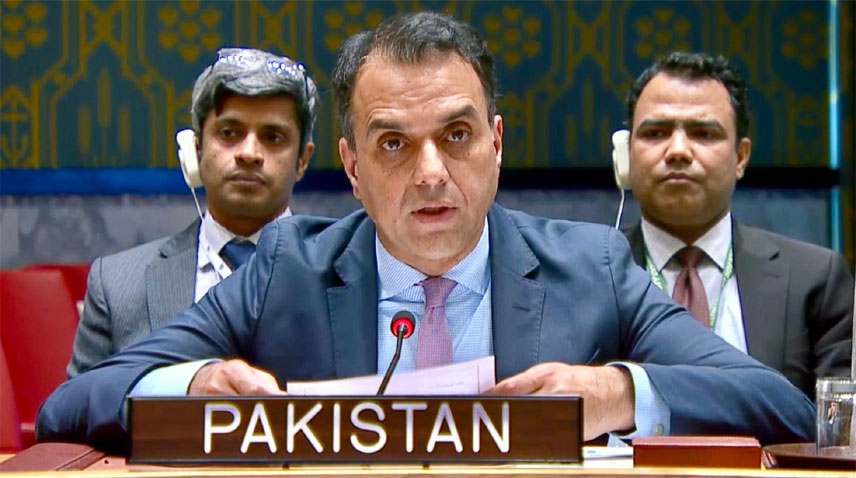
UNITED NATIONS, Dec 24 (APP): As the United States continues to interdict vessels off the coast of Venezuela, Pakistan Tuesday called on all sides to exercise maximum restraint, de-escalate tensions, and refrain from any actions that could further aggravate the already tense situation.
“We firmly believe that the current trajectory serves no one’s interest,” Ambassador Usman Jadoon, deputy permanent representative of Pakistan to the United Nations, told the UN Security Council, which met at the request of Venezuela to consider escalating tensions that Caracas attributes to the U.S. actions.
“In a world marred by polarization with conflicts affecting the lives and livelihoods of millions around the globe, it is all but imperative to once again underscore the centrality and inviolability of the UN Charter and its core principles”, including prohibition on the threat or use of force against the territorial integrity or political independence of any state, he said.
Any unilateral measures contrary to these principles and tenets of international law risk setting dangerous precedents with far-reaching consequences, the Pakistani envoy said.
“We firmly believe that the principles of sovereignty, territorial integrity, and political independence of states, as enshrined in the UN Charter, are sacrosanct.”
Ambassador Jadoon reaffirmed Pakistan’s principled position that any measures undertaken to counter trans-national organized crime or cross-border narcotics drug trafficking must be undertaken in a cooperative manner and should remain in full conformity with international law.
“We urge all sides to engage in diplomacy for peacefully resolving their differences, respecting the imperative of peaceful coexistence and choosing the path of dialogue and cooperation to ensure that the Latin American and Caribbean region is indeed a ‘Zone of Peace’”.
Earlier, United States Ambassador Mike Waltz said sanctions will be enforced to the maximum possible extent to “deprive [Venezuelan President Nicolas] Maduro of the resources he uses to fund” drug cartels.
This, he added, includes profits from the sale of oil, as the sale of oil “enables his fraudulent claim to power and his narco-terrorist activities”.
The United States “will do everything in our considerable power to protect our hemisphere, our borders and the American people”, the US envoy added.
China’s envoy Sun Lei opposed “all acts of unilateralism and bullying” and condemned external interference in Venezuela’s internal affairs under any pretext.
The United States, the Chinese envoy said, must heed the call of the international community immediately, avoid further escalations and uphold the navigation safety of regional countries.
Russian Ambassador Vassily Nebenzya accused US of illegally destroying civilian vessels in the Caribbean Sea, saying Washington is exerting pressure on an independent State whose policy is “not to (it’s) liking”.
Describing the United States’ illegal blockade of Venezuela’s coast as “the clearest and absolutely real act of aggression”, the Russian envoy warned of the catastrophic consequences of such “cowboy-like conduct” for the residents of Venezuela.
On his part, Venezuelan Ambassador Samual Moncada said, “The world must know that the threat is not Venezuela — the threat is the current [United States] Government.”
“It’s not drugs, it’s not security, it’s not freedom; it is oil, it’s the mines, it’s the land,” he warned, adding: “The world knows that, if the scale of armed attacks continues, we will exercise, with all determination, our inalienable right to self-defence.”
Opening the debate, Mohamed Khaled Khiari, Assistant Secretary-General for the Middle East, Asia and the Pacific in the Departments of Political and Peacebuilding Affairs and Peace Operations, said dialogue was the only viable path towards lasting peace and preventing further instability and human suffering.
UN Secretary-General Antonio Guterres stands ready to support all efforts at diplomatic engagement, including the exercise of his good offices, if both parties so request it, Khiari said, adding that the UN chief welcomes initiatives by member states, offers for mediation, and proposals for peaceful solutions.