ISLAMABAD, Dec 20 (APP):At Connex 2025, Jazz Chief Strategy Officer Ali Naseer cautioned that the “Great Detachment” is transforming workplaces, emphasizing that employee engagement now depends on meaning, relevance, and skills rather than mere presence. The leadership segment highlighted this growing challenge, marked by declining engagement and a weakening bond between employees and organizational purpose in the post-COVID era. Ali Naseer, Chief Strategy Officer at Jazz, emphasized that workplace detachment …
Employee engagement hinges on meaning, skills, not presence: Connex 2025
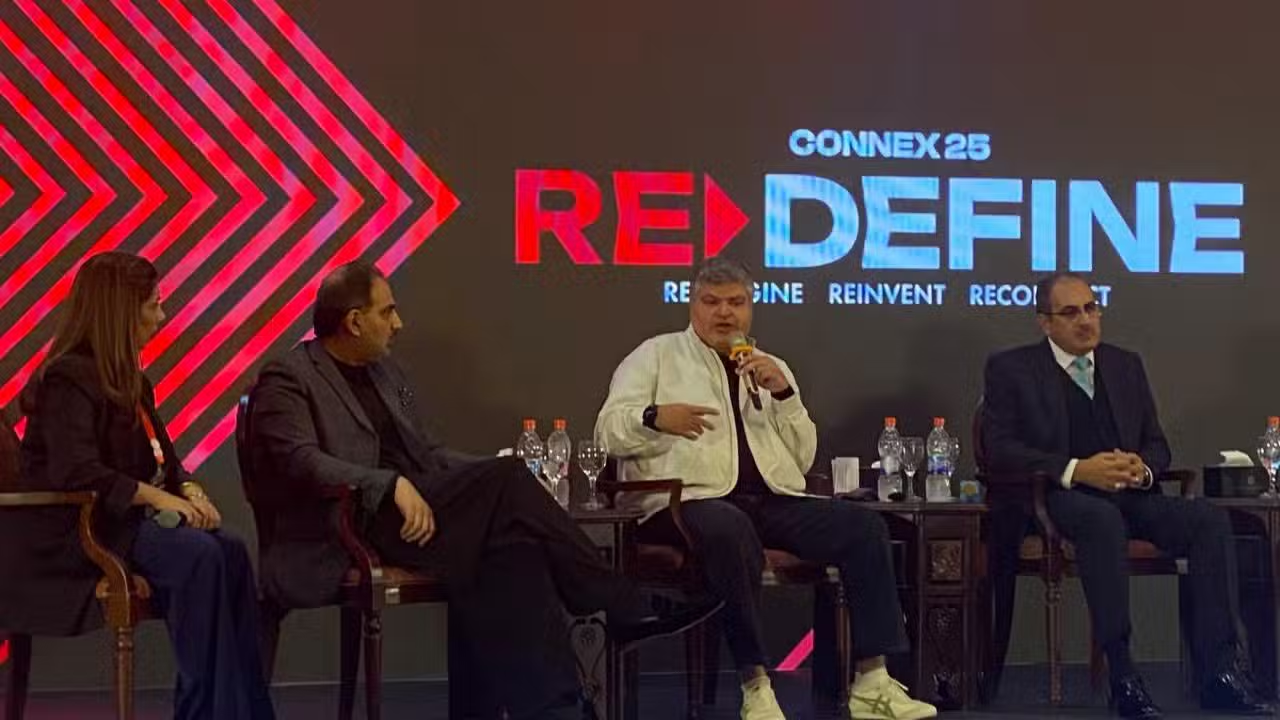
ISLAMABAD, Dec 20 (APP):At Connex 2025, Jazz Chief Strategy Officer Ali Naseer cautioned that the “Great Detachment” is transforming workplaces, emphasizing that employee engagement now depends on meaning, relevance, and skills rather than mere presence.
The leadership segment highlighted this growing challenge, marked by declining engagement and a weakening bond between employees and organizational purpose in the post-COVID era.
Ali Naseer, Chief Strategy Officer at Jazz, emphasized that workplace detachment today is less about location and more about the depth of employees’ connection to their roles, professional growth, and the wider mission of the organization.
He noted that as workplaces become increasingly digital, sustaining engagement requires a sharper focus on relevance, skills, and meaning at work.
Bringing a data-led perspective to the discussion, Ali shared insights from Jazz’s internal people metrics between 2023 and 2025.
He noted that employee churn across the organization has declined over this period, while engagement scores have remained stable, an outcome he attributed to deliberate organizational choices rather than chance.
According to Ali, a key driver of this stability has been Jazz’s sustained investment in learning and capability development. Over the past two years, total learning hours across the organization have surged from 541 to more than 20,000, underscoring a decisive shift toward continuous development and long-term skill relevance.
He added that participation in AI-focused learning programs has expanded significantly, growing from approximately 300 employees to more than 2,600.
This focus on future-ready skills, Ali noted, has helped reinforce employee confidence and alignment at a time when many professionals are navigating uncertainty around how technology will reshape their roles.
Addressing generational change more broadly, Ali cautioned against oversimplified narratives around disengagement. He emphasized that different cohorts have entered the workforce under very different conditions, particularly during and after COVID-19, and that leadership responses must be grounded in empathy, adaptability, and an understanding of evolving expectations.
Technology and artificial intelligence featured prominently in his reflections. Ali described AI as “augmented intelligence,” reinforcing the idea that technology is most powerful when it enhances human capability rather than replacing it.
Drawing parallels with previous waves of innovation, from the industrial age to the internet, he noted that while AI represents a more complex shift, its long-term impact will depend on how effectively organizations equip people to work alongside it.
Perspectives from other panelists reinforced that the Great Detachment is a multifaceted issue shaped by culture, leadership styles, generational dynamics, and how technology is integrated into daily work. While experiences vary across sectors, there was broad agreement that purpose, values, and meaningful connection remain central to sustaining engagement.
The session closed with a clear takeaway: overcoming workplace detachment requires more than technology or structural reforms. Speakers stressed that investing in people, aligning skills with purpose, and combining digital tools with thoughtful leadership are essential to rebuilding connections and fostering engaged, future-ready workplaces.