By Iftikhar Ali UNITED NATIONS, Dec 16 (APP): Pakistan on Monday rejected India's "baseless and misplaced" characterization of its constitutional and legislative processes, saying amendments to the Constitution are the exclusive domain of the elected representative of the people. "India has neither the standing nor the moral authority to question Pakistan’s constitutional processes," Pakistani delegate Gul Qaiser Sarwani told the United Nations Security Council, which held an open debate on …
At UNSC, Pakistan denounces India for questioning its constitutional & legislative processes
By Iftikhar Ali
UNITED NATIONS, Dec 16 (APP): Pakistan on Monday rejected India’s “baseless and misplaced” characterization of its constitutional and legislative processes, saying amendments to the Constitution are the exclusive domain of the elected representative of the people.
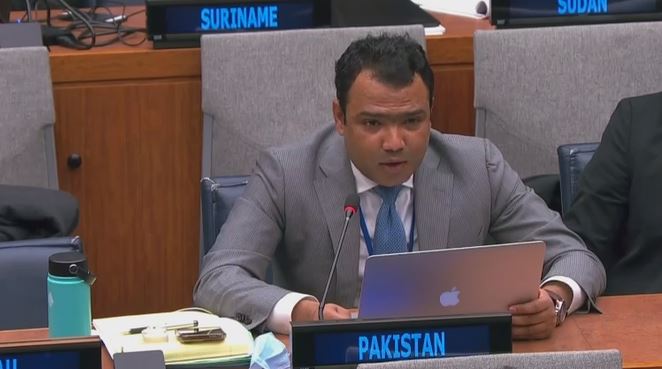
“India has neither the standing nor the moral authority to question Pakistan’s constitutional processes,” Pakistani delegate Gul Qaiser Sarwani told the United Nations Security Council, which held an open debate on ‘Leadership for Peace’ during which members outlined their expectations for the next secretary-general of the UN.
Sarwani, a counsellor and political coordinator at the Pakistani Mission to the UN, was exercising his right of reply to the statement of Indian Ambassador Harish Parvathaneni in which he delved into internal matters of Pakistan, including the recently passed 27th amendment.
The Indian envoy was reacting to Pakistan UN Ambassador Asim Iftikhar Ahmad, who raised the unresolved UN-recognized Jammu and Kashmir dispute while participating in the 15-member Council’s debate, and also highlighted India’s unilateral suspension of the 1960 Indus Waters Treaty in violation of New Delhi’s international obligations.
In his statement, Parvathaneni claimed that Kashmir was an integral and inalienable part of India, adding that New Delhi held the waters treaty in abeyance until Pakistan ends its support for cross-border terrorism.
Sarwani, the Pakistani delegate, called Indian assertions “full of denial and inaccuracies.”
“We reject the baseless and misplaced characterization of Pakistan’s constitutional and legislative processes, which are adopted by the two-third majority of the parliament of Pakistan,” he said.
“Like all parliamentary democracies, constitutional amendments are the exclusive domain of the elected representatives of the people of Pakistan, the Pakistani delegate said.
“India has neither the standing nor the moral authority to question Pakistan’s constitutional processes,” he said, adding, “No one needs any lessons on democracy, or the rule of law from a state whose conduct stands in open contradiction to these principles.”
As regard Kashmir, Sarwani said that India itself brought the matter to the Security Council and accepted the obligation to allow the people of Jammu and Kashmir to determine their future through a UN-supervised plebiscite.
That commitment remains unfulfilled, with India maintaining a massive military presence, suppressing fundamental freedoms, silencing independent voices, and pursuing measures aimed at altering the demographic character of the territory – in gross violation of international law and its legal obligations as the occupying power, he said.
“Let me make it clear, Kashmir is not, it never was and it will never be so called part of India.”
Dismissing India’s allegations of terrorism, the Pakistani delegate said, they “cannot conceal its record of sponsorship of terrorism across its borders, perpetration of state terrorism in occupied Jammu and Kashmir, global state-backed assassination campaign including in North America, and state patronage of violence against its minorities.
“There is credible evidence of India’s sponsorship of terrorist groups, including the TTP, Fitna Alkhwarij, and BLA, Fitna Hindustan, which have carried out attacks in Pakistan.”
Pakistan, he said, has always acted with responsibility and restraint, in exercise of its right to self-defence, through an effective and measured response, as was the case most recently in May 2025, calling India’s claims on the Pahalgam incident “false and predictable”.
In this regard, he said India rejected Pakistan’s offer for an independent, credible investigation into the incident.
“This conduct of the Indian state reflects the mindset of a rogue actor, assuming the roles of judge, jury, and executioner, in blatant disregard of international law and norms,” he said, adding, “There was no self-defence by India; it was a naked aggression against a sovereign state. India’s violation of Pakistan’s sovereignty was responded befittingly by inflicting losses on Indian military and aviation assets – including by downing multiple Indian aircrafts that participated in the aggression.”
Sarwani called India’s remarks on the Indus Waters Treaty “a deliberate distortion of facts and a misinterpretation of a binding international agreement.
“No provision of the Indus Waters Treaty permits unilateral suspension or modification or so-called ‘abeyance’. Such actions amount to the weaponization of water for narrow political gains.
“The Court of Arbitration’s 2025 award reaffirmed the continuing validity of the Treaty and its dispute-settlement mechanisms, upholding Pakistan’s position that all differences must be resolved strictly within the Treaty’s legal framework,” the Pakistani delegate added.
“In spirit of today’s debate,” he added, “leadership for peace demands that India abandon denial, end its occupation of Jammu and Kashmir, cease state-sponsored terrorism, uphold its international obligations, implement UN Security Council resolutions and choose the path of dialogue and good neighborliness.”