ISLAMABAD, Dec 3 (APP): Deputy Prime Minister and Foreign Minister Senator Ishaq Dar on Wednesday stressed the need to re-imagine South Asia and identify pathways to peace, progress, and prosperity by overcoming zero-sum mindsets, fostering an environment of dialogue, peaceful coexistence, economic interdependence, and win-win cooperation. The deputy prime minister, addressing the inaugural session of the two-day Islamabad Conclave 2025 on "Reimagining South Asia: Security, Economy, Climate, Connectivity" held by …
DPM Dar for reimagining South Asia by promoting dialogue, win-win cooperation
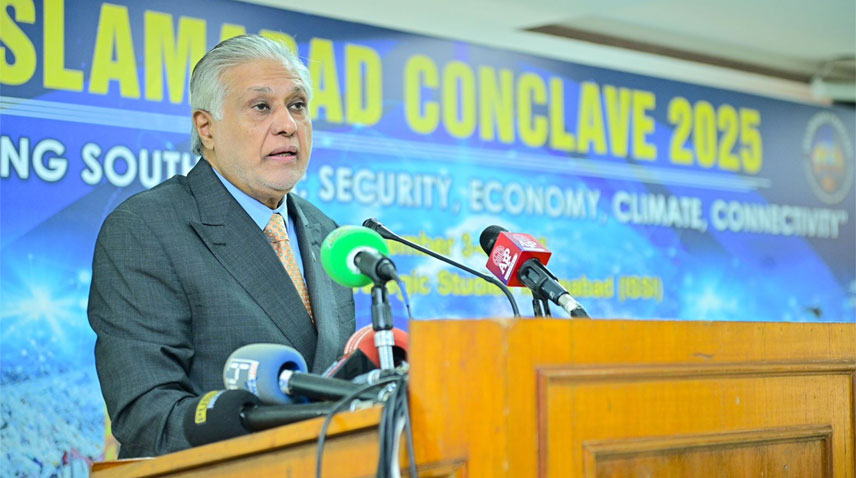
ISLAMABAD, Dec 3 (APP): Deputy Prime Minister and Foreign Minister Senator Ishaq Dar on Wednesday stressed the need to re-imagine South Asia and identify pathways to peace, progress, and prosperity by overcoming zero-sum mindsets, fostering an environment of dialogue, peaceful coexistence, economic interdependence, and win-win cooperation.
The deputy prime minister, addressing the inaugural session of the two-day Islamabad Conclave 2025 on “Reimagining South Asia: Security, Economy, Climate, Connectivity” held by the Institute of Strategic Studies Islamabad, also called for building an edifice grounded firmly in the principles of open and inclusive regionalism.
The event was also attended by Chairman Board of Governors, ISSI Ambassador Khalid Mahmood, ISSI Director General Ambassador Suhail Mahmood, members of the diplomatic corps and foreign policy experts, scholars, academics, practitioners, and speakers from Pakistan and the region.
“Pakistan envisions a South Asia where connectivity replaces divisions, economies grow in synergy, disputes are resolved peacefully in accordance with international legitimacy, and where peace is maintained with dignity and honor,” the deputy prime minister said.
He said that Pakistan remained ready to work with all willing partners to help South Asia realize its immense potential.
He said the global environment continued to be marked by polarisation and fragmentation as conflicts in Europe, the Middle East and Africa, as well as regional crises, including Israel’s genocidal military onslaught on Palestinians in Gaza, represented some of the darkest chapters of recent times.
He said the 92-hour Indo-Pakistan war in May 25, had the potential to escalate to far more dangerous levels. All this is of a large malice in which states have increasingly resorted to the use of force to settle disputes with disregard for international law and the purpose and principles of the UN Charter.
He said that the US played a crucial role in brokering a timely ceasefire between Pakistan and India.
“Pakistan had demonstrated both in resolve and capability to thwart aggression and reinforce deterrence. The concept of a net security provider is buried. Sustainable peace in South Asia, however, requires more than maintaining strategic stability.”
He said that South Asia was faced with escalating disputes over resource sharing, particularly on river waters, as exemplified by India’s illegal and unilateral announcement on the Indus Waters Treaty.
The deputy prime minister said that the long-standing and unresolved political disputes, like Jammu and Kashmir, continued to threaten the peace and stability in the region as the dialogue process between India and Pakistan remained stalled for over 11 years.
Calling climate change an existential threat, he said the rising temperatures, extreme weather events and accelerated glacial melting affected water resources, agriculture and livelihoods worldwide.
Similarly, he said that the rise of extremist ideologies, political populism, democratic backsliding and Islamophobia were negatively impacting the globe and causing upheavals in unprecedented ways.
He said that Pakistan had a clear and consistent vision seeking a just, equitable and inclusive world order and opposing bloc politics and zero-sum approaches. The country also championed UN-centred multilateralism and underscored the indispensability of dialogue and diplomacy, of peaceful settlement of disputes and of international cooperation and solidarity.
Deputy Prime Minister Dar said that as an elected member of the UN Security Council for the term 2025-2026, Pakistan was engaged in efforts to promote international peace and security.
He told the gathering that South Asia, being home to over 25% of the global population, was faced with poverty, inequality and development challenges, including illiteracy, disease, malnutrition, income disparities, food insecurity, natural disasters and the impacts of climate change.
Highlighting the water security threatened by the accelerated melting of glaciers, Dar called for investment in renewable energy, climate-smart farming and disaster preparedness.
Earlier, in his address, ISSI Director General Ambassador Suhail Mahmood said that the fifth edition of Islamabad Conclave had both in-person and online participation of eminent speakers from several South Asian nations.
He said that established in 1973, the ISSI had has evolved structurally as well as substantively by providing research-based inputs and serving as a platform for informed dialogue on issues of policy relevance.
The director general said that Institute will establish an Africa Corner in 2026, scale up its counterterrorism CT research work, deepen collaboration with stakeholders on maritime security and blue economy, spotlight on Pakistan’s contributions at the UN Security Council as elected member for the term 2025-26, strengthen engagement with next-gen international security and IR scholars, and work for the greening of the ISSI building.
Suhail Mahmood also presented to DPM Dar a book on the Operation Bunyanum Marsus of May 2025, an operation representing Pakistan’s robust response to Indian aggression and a firm rejection of any attempt to establish regional hegemony.