ISLAMABAD, Dec 02 (APP): Diplomats, academics and representatives from European missions marked 80 years of German-French reconciliation at an event in Islamabad on Tuesday. The discussion traced how two countries that once fought major wars built a partnership responsible for major steps in Europe’s political, economic and regional integration. Speakers linked this partnership to Europe’s present strength, where French and German economies together form 40% of the European Union’s GDP …
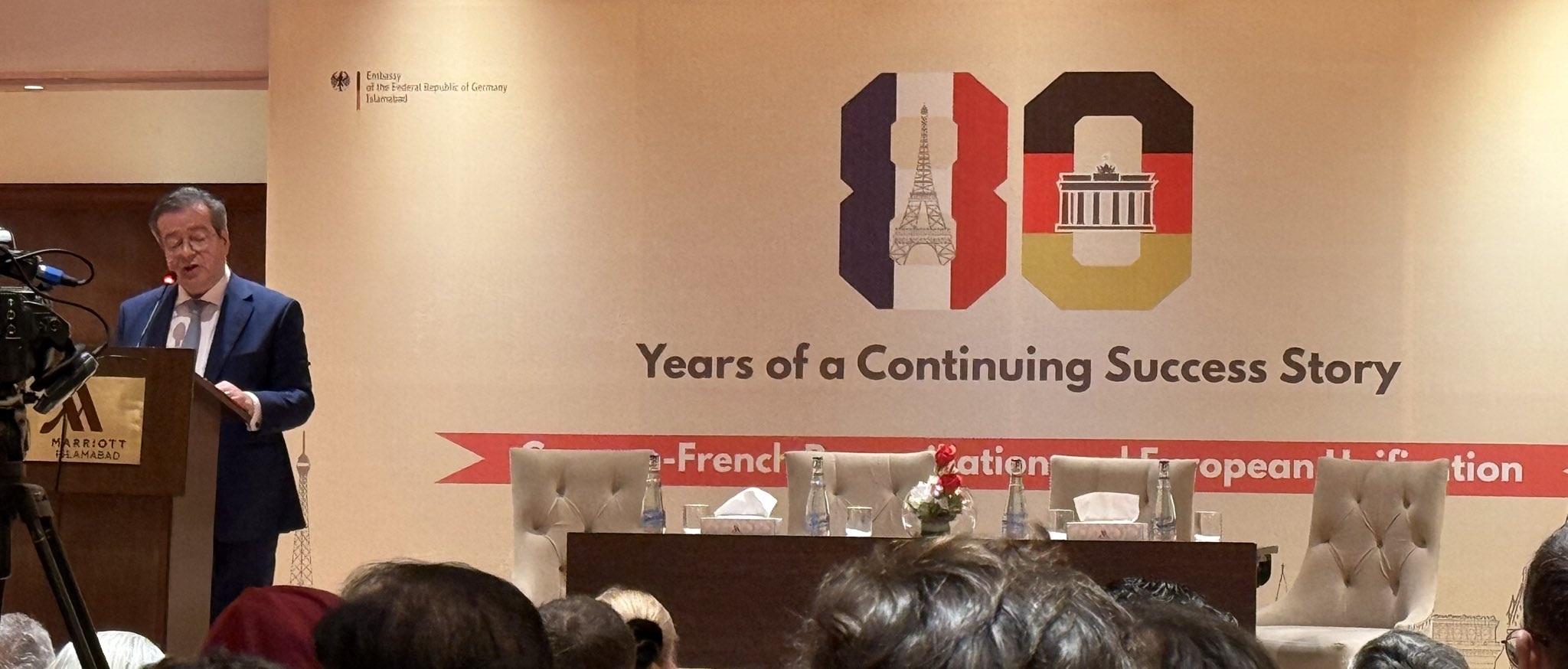
ISLAMABAD, Dec 02 (APP): Diplomats, academics and representatives from European missions marked 80 years of German-French reconciliation at an event in Islamabad on Tuesday.
The discussion traced how two countries that once fought major wars built a partnership responsible for major steps in Europe’s political, economic and regional integration. Speakers linked this partnership to Europe’s present strength, where French and German economies together form 40% of the European Union’s GDP and their populations make up one-third of the bloc.
French Ambassador Nicolas Galey opened the session by recalling the long path that led France and Germany from conflict to cooperation.
He said the partnership proved that countries with a violent past can rebuild relations through consistent political decisions, shared interests and long-term commitments to peace.
Ambassador Galey said the relationship grew after the Second World War, when both countries sought a framework that would prevent future conflicts in Europe. Their leaders sealed this goal in the Élysée Treaty of 1963, signed by General Charles de Gaulle and Chancellor Konrad Adenauer.
By the 1970s, he said, the two governments were describing their alliance as a “Franco-German partnership,” with regular political dialogue and coordinated positions on major European issues. Since then, successive leaders in both countries have kept this foundation intact.
He noted that on 3 October 2025, President Emmanuel Macron attended German Unity Day in Saarbrücken, marking the 35th anniversary of German reunification, showing the continuity of close ties.
The French ambassador said the German-French partnership shaped major policies that led to today’s European structure including the common market, the single currency, financial governance rules, and programs that increased industrial cooperation.
He said the most influential idea came from Jean Monnet, who proposed creating “de facto solidarities” that would tie European economies together to a point where conflict would no longer be possible. This approach became central to European institutions formed after the war.
Ambassador Galey listed joint projects that emerged from this cooperation. These included Airbus, the Ariane rocket programme, and major student exchange initiatives. He highlighted that Pakistani students are the top global beneficiaries of Erasmus Mundus, which evolved from European exchange programs first launched between France and Germany.
He said the strength of the partnership comes from continuous dialogue. The 25th Franco-German Council of Ministers, held on 29 August in Toulon, approved projects in digital sovereignty, trade, industrial development and energy markets.
Both countries have also taken joint positions on the growth of artificial intelligence. In November, German Chancellor Friedrich Merz and President Macron co-chaired a summit in Berlin focusing on Europe’s digital policies.
He referred to Generation Europe, a program launched in 2023 to support future leaders in both countries. The program grew under the Aachen Treaty of 2019 and aims to prepare young professionals who can shape Europe together.
The French ambassador said the partnership now focuses on European defense, especially after Russia’s invasion of Ukraine. He said both governments believe Europe must strengthen its own capabilities and reduce reliance on external actors.
Ambassador Galey said the cooperation extends to Pakistan, where the French and German embassies coordinate closely on political, economic and consular work.
He highlighted a conference the two embassies organized with the Dutch Embassy on 4 November, focusing on press freedom and journalists’ rights. He also mentioned the Franco-German Human Rights Prize, awarded previously to Pakistan’s Sarah Belal in 2016 and Nayyab Ali in 2020.
He added that France’s AFD and Germany’s KfW continue joint development projects in Pakistan, especially in clean energy, where several hydroelectric projects are being financed with local authorities.
The ambassador said Europe faces new challenges, but the German-French partnership still functions as a central force. He said both countries carry responsibility because of their economic weight — 40% of the EU’s GDP — and because their shared history demands continued efforts for peace.
German Ambassador Ina Lepel said the event marks not only official diplomacy but a long record of exchanges between citizens, institutions, universities and youth groups. She said such contact was impossible in earlier generations, who grew up under nationalist and militarist teachings during two world wars.
She said her own parents studied in France as young adults and returned with strong impressions after interacting with French students. She said these exchanges were possible because the first post-war European leaders saw youth contact as a tool for long-term peace.
Ambassador Lepel said leaders in France and Germany after the war made decisions that changed Europe’s path. General de Gaulle supported closer ties with Germany despite leading resistance against Nazi occupation. Chancellor Adenauer pushed for reconciliation and European integration from 1949 to 1963, often against internal resistance.
Later, President François Mitterrand supported German reunification in 1990, despite concerns among political circles in France. He worked with Chancellor Helmut Kohl to advance the European project during the final years of the Cold War.
The ambassador said the partnership became a model for the rest of Europe. Other EU member states expect France and Germany to coordinate positions to guide the wider bloc.
Ambassador Lepel said Europe again faces a challenge of Ukraine war. She said some political groups argue the war is not Europe’s concern, but geography and shared security make it impossible for European countries to ignore the conflict.
She said support for Ukraine is not charity but a necessary response to protect Europe’s stability and democratic systems. She said both France and Germany will continue this support because Europe’s long-term security depends on it.
She said both countries must work even more closely within the European Union and with the United States to safeguard peace. She said Europe remains a destination for people seeking study, work or business, showing the impact of decades of stable policies.
The ambassador thanked Thinkfest, Dr. Muhammad Riaz Shad and Ambassador Jauhar Saleem for organizing the discussion and said the exchange of views with Pakistani scholars offers an important perspective on the history of European unity.