KARACHI, Dec 01 (APP): Sindh Chief Minister Syed Murad Ali Shah, while presiding over a cabinet meeting, discussed and decided on 27 agenda items, including approving the release of Rs6.6 billion for constructing a railway line from Thar Coalfield to Chhor, ordering the blacklisting of a company involved in alleged fraud in the solar project, and endorsing the use of brownfield sites with strategies to attract carbon finance and prioritise …
Sindh cabinet approves Rs6.6 bn railway project, blacklists fraudulent firm, backs climate initiatives
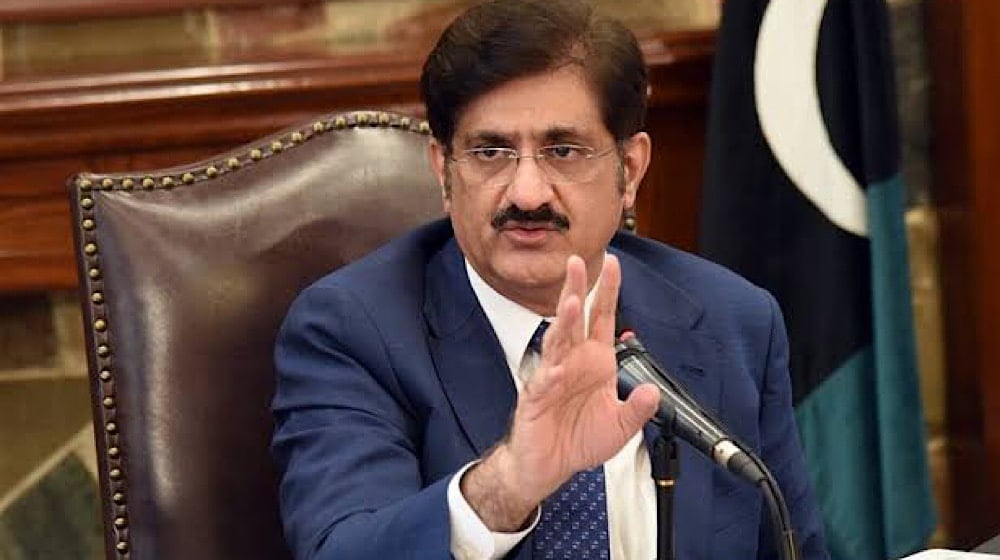
KARACHI, Dec 01 (APP): Sindh Chief Minister Syed Murad Ali Shah, while presiding over a cabinet meeting, discussed and decided on 27 agenda items, including approving the release of Rs6.6 billion for constructing a railway line from Thar Coalfield to Chhor, ordering the blacklisting of a company involved in alleged fraud in the solar project, and endorsing the use of brownfield sites with strategies to attract carbon finance and prioritise climate-friendly solutions.
The cabinet also granted an extension for the deployment of Pakistan Rangers in Karachi and approved a reduction in water rates for DHA from Rs0.75 per gallon to Rs0.60 per gallon.
The meeting, held at CM House, was attended by provincial ministers, advisers, special assistants, Chief Secretary Asif Hyder Shah, and other relevant officers.
The Cabinet considered a proposal from the Local Government Department regarding the revision of the water sale rate applicable to the project “Laying of Pipeline from Dumlottee to DHA and Construction of Pumping Station, Forebay, Filtration Plant and Ancillary Works (through Government-to-Government Agreement).”
Originally, the KWSC set a water sale rate of Rs. 0.85 per gallon for supply to DHA, as approved by the Cabinet and made a condition precedent for the Sindh government’s loan assistance of Rs10.566 billion towards the project’s completion.
Following negotiations with DHA, KWSC proposed revising the water sale rate to Rs. 0.60 per gallon while retaining the payment schedule of 10 years. The revised rate seeks to balance affordability for DHA – already supplying water at Rs. 0.75 per gallon through bowsers – with the project’s financial sustainability.
The Cabinet approved the revised water sale rate of Rs. 0.60 per gallon for DHA.
Digitalisation of authenticated Record of Rights & e-transfer of land titles.
The Sindh Cabinet, in principle, has approved a groundbreaking project aimed at overhauling the province’s land management. This project, led by the Board of Revenue, assigns Sukkur IBA University the task of developing and implementing a digital land record system. In its pilot phase, data entry work is nearly complete, and there is a clear plan to extend this digitisation effort to every district within three years.
At the core of these changes, the government will first verify and rewrite all current land records, moving them into a blockchain-based digital database. Sukkur IBA University will handle both software creation and technical support to keep the project on track. A new Sindh Land Records Authority will supervise this transition and ensure land transfers become fully digital. The platform integrates with national bodies like NADRA and the FBR and uses GIS mapping to visualise land boundaries.
The new system introduces an online portal where people will upload documents, verify their identities using biometrics, pay fees, and receive a digital land title all securely recorded on the blockchain.
To make this happen, the government is proposing updates to existing land revenue laws, paving the way for digital management and electronic title transfers. The CM directed the Board of Revenue (SMBR) to prepare a bill and bring it to cabinet to review and, if passed, set up a transparent, fully digital land registration process for Sindh.
It has also been proposed that owners of immovable property will be issued a digital card instead of a traditional file. This card, containing a digital SIM, will provide access to all documentation related to the property.
The cabinet was briefed on the progress of the Islamkot–Chorr railway line, the double-track link between Bin Qasim and Port Qasim, and the proposed coal unloading facility. The joint venture agreement signed in March 2025 between the Sindh Energy Department and the Federal Ministry of Railways, the project’s revised PC-1 had escalated from Rs 53 billion to over Rs 90 billion.
The meeting was told that the federal government has released Rs 18.7 billion as its share and has urged Sindh to release its allocation to avoid delays. Chief Minister Murad Shah, with the approval of the cabinet, directed the Finance Department to release Rs 6.610 billion consider further funding based on the executing agency’s requirements.
The Sindh Solar Energy Project, funded by the World Bank and set to close in July 2025, has encountered major problems despite nearly full use of its allocated budget. Many core goals, such as building solar parks, installing rooftop systems, and distributing home solar kits, have not been met.
There were improper contract modifications, payments made for incomplete or missing work, and critical issues with imports – including fake documents presented by the main contractor, causing large financial losses. Additionally, some NGOs were hired for distribution work without open competition, and significant funds were spent on unclear or undocumented equipment. In response, the Chief Minister has ordered thorough audits, investigations, and blacklisting of the involved companies to protect public money and enforce accountability.
The Solar Home System Project is a major Rs 18.8 billion effort to provide 250,000 free solar kits to low-income families, split between off-grid and on-grid communities. The kits, each containing a solar panel, battery, charge controller, fan, LED lights, and charging ports, come with a two-year replacement warranty.
Distribution is led by NRTC-E and supported by NGOs, focusing on poor households in hard-to-reach off-grid areas and low-power on-grid consumers, excluding those who have previously benefited from similar programs.
Applicants are selected based on affidavits and a transparent system that employs electronic balloting if the interest exceeds available kits. Monitoring relies on a central database and mobile app for real-time tracking and verification, with a dedicated steering committee providing high-level oversight to ensure the project’s goals and transparency are met. Work is coordinated with the Sindh People’s Housing Foundation to strengthen management and accountability processes.
The Sindh cabinet endorsed an environmental initiative to redevelop neglected brownfield sites by leveraging carbon finance and climate-friendly solutions. The Environment Department, with support from the Ministry of Climate Change, identified unused and contaminated lands suitable for redevelopment.
The Energy Department plans to transform old industrial lands into solar parks and wind farms, as well as convert dumping grounds into biogas and waste-to-energy facilities. The Forest Department aims to increase greenery by developing new forests and wetlands, while the Local Government Department plans to upgrade sites like Jam Chakro into modern landfills.
The cabinet approved natural restoration solutions, such as mangroves and urban forests. Sindh is committed to the national strategy and will advocate for broader, nationwide adoption.
Amendments in Rules. The Sindh government cabinet approved updates to its Rules of Business to bring newly created environmental institutions into official schedules. The Sindh Environmental Protection Agency and the Sindh Environmental Protection Tribunal, along with the newly merged Directorate of Climate Change & Carbon Finance, are now listed as attached departments under Schedule-I. The Sindh Coastal Development Authority, because it operates independently, is included in Schedule-II. These changes provide proper recognition and clarify administrative arrangements for these organizations.
Sindh Modaraba garnted Rs2bn to expand its Islamic financing.
Sindh Modaraba, established in 2013 in tribute to Shaheed Mohtarma Benazir Bhutto, has shown steady growth in the Islamic finance sector. Over the years, its paid-up capital has reached Rs. 1.5 billion through periodic injections from the government.
In the last three years, the institution’s assets grew from Rs. 1.778 billion to Rs. 2.065 billion, and equity climbed from Rs. 1.722 billion to Rs. 1.992 billion. The Islamic financing portfolio has also expanded, even as profit before tax decreased due to a major policy rate cut by the central bank. Notably, Sindh Modaraba has kept its non-performing loan ratio very low at 1.26 per cent and posted record recoveries. It has diversified exposure, with most financing going to the agriculture sector, as well as clients in health, chemicals, textiles, and steel.
The company has maintained high A+ and A1 credit ratings for eight consecutive years. Its achievements include dividends paid to the Sindh government, humanitarian support for flood victims, and consistent loan recoveries. In the most recent year, it disbursed a record Rs. 1.518 billion, compared to just Rs. 274 million the prior year.
The cabinet, for Sindh Modaraba, approved Rs. 2 billion in equity (Rs1 billion during 2025-26 and another Rs1 billion during 2026-27) over the next two years, projecting steady growth in profits, portfolio size, and organisational scale through new branches, more staff, and enhanced reserves.
The Home Department presented a summary regarding the extension of Pakistan Rangers (Sindh) deployment in Karachi Division under the Anti-Terrorism Act, 1997. The cabinet was informed that Rangers are currently deployed to assist Sindh Police in maintaining law and order and are legally empowered under the Anti-Terrorism Act to perform functions necessary for countering terrorism and violent crime.
After deliberation, the cabinet approved the proposal to request the Ministry of Interior for a further one-year extension of the deployment of Pakistan Rangers (Sindh) in Karachi Division, effective from 9 December 2025.
The cabinet was told that, in its meeting on 20 November 2025, it had approved in principle the Education City Land Allotment Rules and Education City Regulations and constituted a five-member committee to finalise the documents. The committee, which met on 27 November 2025, examined the rules and regulations and found them in order. It further directed that the Government of Sindh’s prevailing Statement of Conditions for allotment of state land be formally adopted by the Education City Board. The approved minutes of the committee meeting were presented before the cabinet, which ratified the decisions.
The Sindh Cabinet has formally endorsed the financial agreements for the Asian Development Bank (ADB) and Green Climate Fund (GCF)-supported Sindh Coastal Resilience Sector Project (SCRSP). This milestone moves the project forward after successful loan negotiations amounting to $180 million in loans and grants, with an additional $20 million as counterpart funding from the Government of Sindh. The SCRSP, to be jointly implemented by the Irrigation and Forest & Wildlife Departments, aims to enhance coastal region resilience through integrated water, drainage, and flood management schemes, as well as large-scale mangrove and native species plantation for shoreline and flood protection.
The project is set for completion by 31 December 2031. The international financing arrangements, which include a 20-year ADB concessional loan, a 30-year GCF loan at 0% interest, and a non-repayable GCF grant, were negotiated and ratified in a meeting held on 7 November 2025. With the cabinet’s approval, the SCRSP now proceeds for detailed implementation as part of Sindh’s broader efforts for sustainable coastal development.