Across China: Traditional goose farming city becomes global badminton production base
Across China: Traditional goose farming city becomes global badminton production base
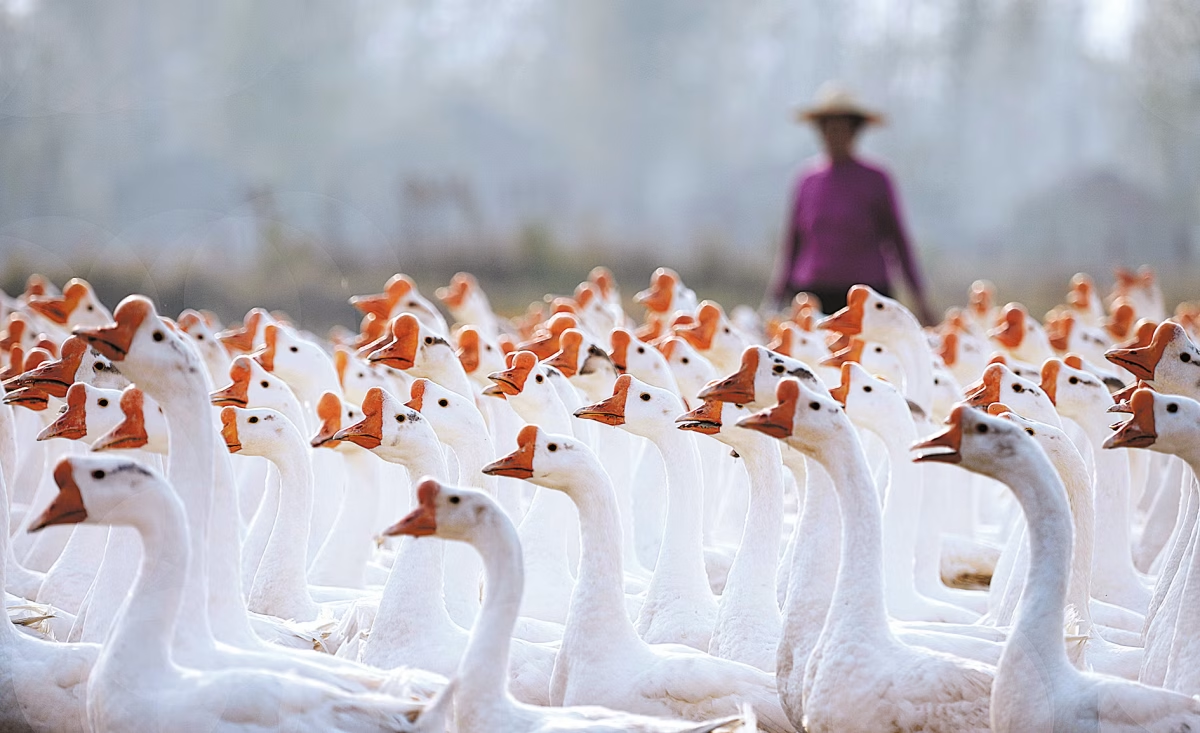
HEFEI, Dec. 1 (Xinhua/APP): By harnessing AI and automation, Lu’an City in east China’s Anhui Province, a historic goose-breeding hub, has transformed itself into a key global supplier of feathers — the core raw material for the badminton industry.
The goose breeding tradition in Lu’an dates back to the Ming Dynasty (1368-1644). “Nowadays, the growth cycle of over 200 days of the Wanxi White Goose assures the good quality of its feathers, which are in high demand on the global market,” said Jiang Weijun, head of a local agricultural company and supplier of badminton feathers.
The feathers of the local goose species are not only visually appealing due to their white color, but are also larger, thicker, and have more flexible quills than average. This combination of traits makes them well-suited for producing shuttlecocks with stable flight and high durability.
In recent years, as the value of these feathers became better known, local farming has shifted from small household operations to larger-scale breeding. The use of controlled-environment goose houses and off-season breeding techniques has helped increase the supply and quality of the feathers.
“Currently, about 14 million Wanxi White Geese are raised in Lu’an each year, but the growing supply of feathers still cannot meet the demand,” Jiang said.
After collection, the feathers go through dozens of steps, including sorting, washing, drying and assembling, before being turned into finished shuttlecocks.
Not just a source of raw materials, Lu’an has become a major production base for Chinese and international badminton brands. According to statistics, the value of badminton exports from Lu’an last year was 21 million yuan (about 3 million U.S. dollars), up 8.2 percent year on year.
Driven by a reliable supply of high-quality feathers and supportive local policies, Xin’an Town in Lu’an has become a key production base in the supply chain for global brands such as Yonex, RSL and Kawasaki. The town produces 3.6 million tubes of shuttlecocks each year, which are sold to more than 10 countries, including Indonesia, Malaysia and Thailand.
Automation and artificial intelligence are now being used to improve production. At the Yuxiang Sporting Goods factory, a worker places raw feathers into an intelligent sorting machine. The machine uses AI to quickly check and sort the feathers into 21 different categories.
“A worker could sort 20,000 feathers a day by hand, but a machine can sort 250,000 a day,” said Zhang Xinsheng, head of the company. He said the machine was developed with a Chinese university and is now in its fourth generation.
This company can produce 800,000 tubes of shuttlecocks per year and has become one of the production bases for the globally renowned brand Yonex. “We are also developing robotic arms to make production more efficient in the future,” Zhang said.
Beyond shuttlecocks, Lu’an is also developing other feather products. Down feathers from the geese are used to make jackets and other goods sold overseas. According to local authorities, the city’s sporting goods industry is expanding to include the production of badminton rackets, clothing and shoes, building a more complete sports manufacturing chain.