
At Kashmir Black Day event, speakers warn peace will elude South Asia without Kashmir dispute resolution
At Kashmir Black Day event, speakers warn peace will elude South Asia without Kashmir dispute resolution
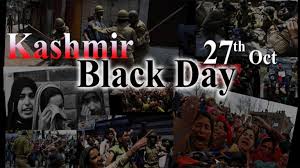
NEW YORK, Oct 27 (APP): Speakers at Kashmir Black Day event called on the world community and the United Nations to honour the commitments made to the Kashmiri people and allow them to exercise their UN-pledged right to self-determination, warning that that durable peace in South Asia was not possible without a just resolution of the Kashmir dispute.
They also paid rich tribute to the Kashmiris for their exemplary sacrifices and defiance of the Indian occupation forces in their struggle to seek their inalienable right to freedom from occupation in line with UN Security Council resolutions.
Kashmir Black Day is commemorated annually on October 27 to mark the day in 1947 when India, without any legal justification, forcibly took control of the State of Jammu and Kashmir.
The event, hosted jointly by the Permanent Mission of Pakistan to the UN and the Consulate General of Pakistan in New York under the theme of ‘Demographic Engineering and Colonial-Settler Project in Indian Illegally Occupied Jammu and Kashmir (IIOJK)’, was attended by people belonging to different walks of life including the representatives of the Kashmiri community.
Among those who spoke on the occasion were Saud Sultan, researcher and author of the book on Kashmir entitled “The Forgotten Narrative”; Ejaz A. Sabir, legal advisor and the founding member of Sabir Law Group.; Sardar Sawar Khan, former member of the Kashmir Council and veteran Kashmiri leader; Raja Mukhtar Khan, spokesperson of the Jammu and Kashmir Liberation Front, USA; Muhammad Taj Khan, Kashmiri activist and community leader.
Consul General Aamer Ahmed Atozai delivered welcome address.
In a keynote speech, Ambassador Asim Iftikhar Ahmad, Permanent Representative of Pakistan to the UN, reaffirmed Pakistan’s unwavering commitment to the just cause of the people of Jammu and Kashmir. Pakistan, he said, continues to raise the Kashmir dispute at the United Nations from multiple dimensions — including human rights, peace and security, the territory’s legal status as well as the broader implications for international law.
There was complete national consensus across Pakistan’s political spectrum in support of the Kashmiri people’s struggle for their inalienable right to self-determination, as enshrined in the UN Charter and relevant Security Council resolution, he said.
The Pakistani envoy highlighted that India’s unilateral and illegal actions since August 2019 — including land confiscations, demographic engineering through new domicile laws, and gerrymandering — constitute elements of a colonial settler project in clear violation of the Fourth Geneva Convention.
Drawing parallels between the situation in Indian occupied Kashmir and Palestine, he underscored that the recent Advisory Opinion of the International Court of Justice (ICJ) on the legal consequences of occupation could be meaningfully applied the Himalayan state. He called for a thorough assessment of the impact of India’s coercive policies on the daily lives, rights, and identity of the Kashmiri people.
Ambassador Asim Ahmad lauded writer Saud Sultan for his clarity, boldness, and commitment to truth, as reflected in his book “The Forgotten Narrative.”
Pakistan and Kashmir, he added, are bound by a shared history, emotion, and destiny — stating that their hearts beat together in the pursuit of justice and freedom.
“India has lost the battle for hearts and minds in IIOJK,” he remarked, adding that Prime Minister Shehbaz Sharif’s address at the UN General Assembly in September once again reaffirmed Pakistan’s principled stance and enduring support for the Kashmiri people until they realize their right to self-determination.
Aamer Ahmad Atozai, the Consul General, stated that the people of Indian-occupied Kashmir continue to write an eternal story of sacrifice, suffering, and steadfastness. Neither guns, nor oppression has silenced their voices. “Even today, one cry echoes in every Kashmiri heart — ‘What do we want? Freedom from Indian tyranny and brutality!’” he said.
The Consul General added that on August 5, 2019, India committed yet another act of oppression by revoking Jammu and Kashmir’s special status, attempting to erase its identity, alter its demographic composition, and seize its lands. He termed the Indian action a blatant violation not only of United Nations resolutions but also of international humanitarian law.
“History bears witness to one truth: no power can silence the voice of justice forever,” he added.
Saud Sultan, a Cambridge-affiliated scholar and author, reframed the Kashmir dispute through the prism of settler colonialism and deliberate historical erasure. Kashmiri voices have been systematically excluded from academic and historical narratives, citing the silenced memory of the Jammu Massacre—where over two hundred thousand Muslims were killed—as emblematic of India’s attempt to obscure the truth.
Sultan also emphasized that the struggle in Jammu and Kashmir transcends religion, embodying a quest for self-determination and dignity. He positioned the issue within a broader matrix of colonial subjugation, demographic manipulation, and violations of international law, urging a revival of intellectual and moral engagement with the authentic Kashmiri narrative.
Ijaz A. Sabir, the first Kashmiri attorney to advance the issue at international legal forums, delivered a precise legal indictment of India’s occupation of Jammu and Kashmir. Referencing the Fourth Geneva Convention, the UN Charter, and the International Covenant on Civil and Political Rights, he asserted that India’s demographic reengineering, population transfers, and coercive governance constitute breaches of international humanitarian law and clearly represent acts of settler colonialism.
Ijaz Sabir underscored that eighteen UN resolutions affirm Kashmir’s disputed status and its people’s inalienable right to self-determination.
Rejecting sectarian framings, he described the crisis as a legal and moral challenge to the global order and commended Pakistan’s principled commitment to the Kashmiri cause as a testament to its enduring solidarity and faith in justice for the oppressed people of Jammu and Kashmir.
Veteran Kashmiri leader Sardar Sawar Khan exposed Indian falsehoods and lies by shedding light on the history of the illegal and immoral Indian occupation of Jammu and Kashmir in 1947.
He said that the Two-Nation Theory, which was the basis of the partition of the subcontinent, should have applied to Jammu and Kashmir, as Kashmiris wished to accede to Pakistan.
Sawar Khan called out Indian leaders Jawaharlal Nehru and Sardar Patel for their machinations and ulterior motives to occupy Kashmir, adding that the Muslim Conference, a representative Kashmiri organization, had already adopted a resolution on July 19, 1947, in favour of joining Pakistan. He noted that since IIOJK remains a disputed territory, India’s enactment of 38 laws, including those passed in August 2019, violates international law and UNSC resolutions. He thanked the people and government of Pakistan for their consistent support to the Kashmiris.
Raja Mukhtar Khan, spokesperson of JKLF, USA, stated that India has shown no inclination to enter into meaningful dialogue with Pakistan to resolve the Jammu and Kashmir dispute. He emphasized that the Two-Nation Theory also applied to Jammu and Kashmir, where 80% of the population, being Muslim, clearly wished to join Pakistan.
While thanking the people and government of Pakistan on behalf of the Kashmiri community, Mukhar Khan said that Pakistan has fought five wars with India in defense of their rights. He added that it was due to Pakistan’s active advocacy and deft diplomacy that the Kashmir cause remains alive.
In his remarks, Kashmiri activist Taj Khan stated that Indian Prime mInister Narendra Modi was being increasingly exposed globally for his oppressive policies in IIOJK. He said there were unmistakable signs of India forming a nexus with Israel in implementing a colonial-settler project in IIOJK.
Taj Khan concluded by saying that Kashmiris hold immense love and respect for the people of Pakistan, and the day is not far when Jammu and Kashmir will be free from Indian occupation.
Earlier, Ambassador Usman Jadoon, deputy permanent representative of Pakistan to the UN and the minister at the Mission, Asif Khan, read out the messages of President Asif Ali Zardari and Prime Minister Shehbaz Sharif marking the Kashmir Black Day.
Saud Sultan also presented his book to Ambassador Asim Ahmad and Consul General Atozai on the occasion.